A pilot has come up with a unique way of proposing to his girlfriend.
It's just unbelievable that Ryan Thompson proposed to his girlfriend, Carly Kennedy, by pretending the plane he was piloting was just getting out of control and might be crashed.
You see, Ryan Thompson tricked Carly Kennedy into thinking the plane was
going down and the flight controls weren’t responding so she could read
him the instructions on what to do. Those instructions were, of course,
altered to reveal his proposal.
"The checklist is complete ... and it says the rings may be engaged ...
and to initiate the ring engagement procedure," his girlfriend reads. "Will you marry me?"
she continues, taking several seconds to realize that the plane wasn't
actually about to go down. Luckily for Thompson, his girlfriend was
impressed by the stunt and accepted the "In Descent Proposal."
Appearing on Good Morning America, Kennedy said: "I genuinely did believe that we were going to die.
"I felt that our lives depended on me reading that checklist."
She added: "A lot of women that I've the told story to have said, 'I would have slapped him'."
Watch video below:
Report Tags:
Ryan Thompson, Carly Kennedy, Video, Youtube, Viral Video, Faking Plane
Crash, Pretending Plane crash, Pilot proposing during plane crash
After an amazing success of ‘Barack Obama singing Lady Gaga's Born This Way’ generating almost 3 million views, the guys with Youtube ID of baracksdubs have come up with another Youtube buster called "Barack Obama Singing Sexy and I Know It by LMFAO [OFFICIAL]".
Barack Obama Singing Sexy and I Know It by LMFAO
The latest creation by baracksdubs have an instant success and gone viral producing almost 3 million hits since being uploaded three days ago on March 26.
Barackdubs is a famous YouTube channel which features clips of speeches from the U.S. President Barack Obama cut together and set to music to make it appear as if President is singing along to a popular song.
Before you watch this video; you might think you're pretty good at table tennis, but that's just because you haven't met baby Jamie yet.
18-month-old Jamie Myska-Buddell playing Table Tennis
Just check out the amazing Ping Pong/Table Tennis skills of few months old baby Jamie Myska-Buddell. 18-month-old Jamie Myska-Buddell features in a two-minute video returning balls bounced across the table by his dad.
AMAZING !!! Wild lion launches a wild attack at a little 3-year-old girl Sofia Walker through the zoo viewing glass.
The lions’ enclosure is very large and gives the lions plenty of playing area and privacy. The animals are all taken good care of to a 5 star zoo quality.
Three-year-old Sofia Walker faces wild ilon bravely at Wellington zoo, New Zealand
What made me share this video is the spontaneous and brave reaction of the little girl. She continued to stare despite on a wild response by the beast.
Three-year-old Sofia Walker didn't even flinch as the male beast struck the glass with his paws repeatedly.
Captured on camera by her parents, the youngster seemed to be completely unfazed by Malik's actions.
She bravely stood her ground as the grumpy lion showed her what he thought of her interrupting his breakfast at Wellington Zoo in New Zealand.
Sofia appeared completely unworried as eight-year-old Malik attacked.
"I was brave," Sofia said of her encounter with Malik, whose food was nearby in his enclosure.
"Maybe it felt threatened that Sofia might try and take it, or that he would prefer to eat her," said her father Julian.
Sofia turns four next month and wants to return to the zoo.
A video footage has buzzed on the web showing a driver's face-off with certain death after almost crashing into a jack-knifing truck on a snowy road in Russia. The heart-stopping moment was captured on a video recorder installed in the car coming from opposite side.
The Google Let it Snow feature have recently gone viral and thousands of people have searched for the “let it snow” search term that will allow you to see the feature. The Let it snow song originally written by Sammy Cahn and composed by Jule Styne 66 years ago in 1945 probably never had so many people searching for the song at the same time.
"Let it Snow" - Only on Google Chrome and Firefox
Google have also added a created a button that will allow you to clear your screen once it is frozen up completely. To clear your screen simply click on the “Blue Defrost Button” on the top right side of your screen and the snow effect will disappear.
As far as we can tell the “Let it Snow Google” Surprise is not working in Internet Explorer 9. If you cannot see the “Google Let it Snow feature” you can watch it in Google Chrome or in Firefox. Both the Google Chrome and the Firefox browsers support the Let it Snow feature.
But if you have only Microsoft's Internet Explorer then watch it here below ... Let it Snow, Let it Snow, Let it Snow, Let it Snow .....
A homeless American, Ted Williams, became an instant internet sensation for his a deep and refined voice when a local reporter accidently ‘discovered him on a street corner in Columbus, Ohio.
The 53 year-old Williams had been offered a job by the NBA's Cleveland Cavaliers after getting fame from this video. Before this lucky-go-merry incident; Williams was living in a tent and notoriously known for his arrests and jail terms due to thefts and forgeries.
Williams' New York-based mother Julia was excited that her only child was turning his life around by any mean.
Horn-blowing prankster Sergio Flores, aka Sexy Sax Man, just started showing up in random places to entertain and/or annoy passers-by with his searing rendition of "Careless Whisper." Sergio Flores is now sponsored by Oleg Saxophones! These horns are known for having the best sound and intonation.
Views (as on Dec. 17, 2011): 11,530,827
Continue reading and watch the number one in list below:
NAGPUR, India (Dec. 18) – The Guinness Book of World Records Friday named India’s Jyoti Amge as the world’s shortest living woman taking the title from American Bridgette Jordan. Jyoti Amge is just 62.8 centimeters (24.7 inches) tall, 6.2 cm shorter than 22-year old Jordan, who has held the title since September 2011.
India's Jyoti Amge: The Shortest Living Woman (Guinness World Record)
Jyoti Amge, a student from Nagpur, celebrated her 18th birthday on Friday in her native city. Amge said, “It is wonderful to celebrate my 18th birthday with a new world record, it’s like an added birthday present.” She has just passed her Class 10 exam and intends to take up acting full time.
Representatives from Guinness World Records measured her at a ceremony attended by about 30 relatives and friends in Nagpur.
Rob Molloy, official adjudicator for Guinness World Records told: “She’s 62.8 centimetres. She was measured three times over the last 24 hours as height can vary slightly according to the time of day. Doctors measured her in our presence at three different times, both standing up and lying down. We took an average.”
India's Jyoti Amge: The Shortest Living Woman (Guinness World Record)
India's Jyoti Amge: The Shortest Living Woman (Guinness World Record)
India's Jyoti Amge: The Shortest Living Woman (Guinness World Record)
India's Jyoti Amge: The Shortest Living Woman (Guinness World Record)
India's Jyoti Amge: The Shortest Living Woman (Guinness World Record)
Watch below the official video from Guinness World Records measuring and giving Jyoti Amge the plaque:
LONDON (Nov. 15) – No one on this planet, who knows ABC of internet, will be unaware of YouTube – the leading video sharing website.
According to media reports; a 56-seconds video uploaded by a British family has recently earned whopping £100,000 pound sterling. It seems unbelievable but it’s true. YouTube often divides, among the users, the income generated from advertising running alongside videos.
An in this case; the 42-year-old Howard Davies-Carr received 100,000 GBP who uploaded a video – Charlie bit my finger again! - of his two kids, Charlie and Harry. The video has been viewed by more that 387 million times since it was uploaded four year back.
Today morning when I started searching updates about the fallen NASA satellite; I came across this video and can't stop myself from laughing. It’s FUNNNNY!
Everything, doesn’t matter how serious it is, can be used to entertain people in this world. The script is awesome and the expressions on the faces of people are just unbelievable.
Last but not the least the entry of NASA officials, men in black, in a big van is really dramatic to add the extra fun in this little drama.
Eid ul-Fitr is one of the most significant festivals among the Muslims. It marks the end of the month of Ramazan also known as Ramadan, the month of fasting. In Arabic language Eid means festivity. Eid ul-Fitr means Festival of Breaking the Fast. This festival falls on the first day of the month of Shawwal, which is the tenth month according to the Islamic Calendar.
Eid ul-Fitr 2011 (1432 AH)
Eid ul Fitr is a unique festival. It has no connection with any historical event nor is it related to the changes of seasons or cycles of agriculture. It is not a festival related in any way to worldly affairs. Its significance is purely spiritual. It is the day when the Muslims thank Allah (SWT) for having given them the will, the strength and the endurance to observe fast and obey His commandment during the holy month of Ramadan.
Hazrat Anas (ra), a companion of prophet Muhammad (peace be upon him) reported that when the Prophet Muhammad (PBUH) migrated from Makkah to Madinah, the people of Madinah used to have two festivals. On those two days they had carnivals and festivity. Prophet Muhammad (PBUH) asked the Ansaar (the Muslims of Madinah) about it. They replied that before Islam they used to have carnivals on those two joyous days. The Prophet Muhammad (PBUH) told them: 'Instead of those two days, Allah has appointed two other days which are better, the days of Eid-al-Fitr and Eid-al-Adha.' (Hadith)
To be found in the Suleiman Hills, Khyber Pass is one of the most famous passes in the world. The Khyber Pass is situated about 16 kilometers west of Peshawar and extends to Afghanistan border.
The Khyber Pass is a 53-kilometer (33-miles) passage through the Hindu Kush mountain range. It connects the northern leading edge of Pakistan with Afghanistan. At its narrowest point, the pass is only 3 meters wide. On the north side of the Khyber Pass rise the towering, snow-covered mountains of the Hindu Kush. The Khyber Pass is one of the most famous mountain passes in the World. It is one of the most important passes between Afghanistan and Pakistan. It is the best land route between India and Pakistan and has had a long and often violent history. Conquering armies have used the Khyber as an entry point for their invasions. It was also been a major trade route for centuries.
Importance:
Khyber Pass, mountain pass in western Asia, the most important pass with reference to Afghanistan and Pakistan, controlled by Pakistan. The Khyber Pass winds northwest through the Sefid Koh Range near Peshawar, Pakistan to Kabul,Afghanistan, varying in width from 3 to 137 m. The mountains on moreover side can be climbed only in a few places. The pass is walled by precipitous cliffs that vary in height from about 180 to 300 m. The pass reaches its highest elevation at the border between Afghanistan and Pakistan. The area of the Khyber Pass has been connected with a imitation arms industry, making various types of weapons known to gun collectors as Khyber Pass Copies, using local steel and blacksmith forges. During the current war in Afghanistan, the Khyber Pass has been a most important forward for re supplying NATO forces in the Afghan theater of conflict. Recognizing this, the Taliban attempted to choke off the route in late 2008 and early 2009, bringing the Taliban into conflict with the Pakistani government.
In February 2009, a bridge 15 miles northwest of Peshawar was blown up by militants presumably sympathetic to or sponsored by the Taliban. While it was not considered to be a major strategic blow to the allied war effort, it invigorated hard work to secure additional supply routes, some of which may ultimately run through Iran. However, the current general consensus is that the new supply route will pass through various central Asian republics to the north of Afghanistan.
History:
The history of the Khyber Pass as a strategic doorway dates from 326 B.C., when Alexander the Great and his army marched through the Khyber to reach the plains of India. From their, he sailed down Indus River and led his army across the desert of Gedrosia. In the A.D. 900s, Persian, Mongol, and Tartar armies forced their way through the Khyber, bringing Islam to India. Centuries later, India became part of the British Empire, and British troops defended the Khyber Pass from the British Indian side. During the Afghan Wars the pass was the scene of numerous skirmishes between Anglo-Indian soldiers and native Afghans. predominantly well known is the battle of January 1842, in which about 16,000 British and Indian troops were killed. The British constructed a road through the pass in 1879 and rehabilitated it into a highway during the 1920s. A railroad was also built here in the 1920s.
The Khyber, in its plaid history, has seen countless invasions. It witnessed the march of Aryans and victorious move forwards of Persian and Greek armies. It also saw the Scythians, White Huns, Seljuks, Tartars, Mongols, Sassanians, Turks, Mughals and Durranis making successive inroads into the territories beyond Peshawar Valley and Indus. The very sight of the Khyber reminds one of the conquerors who forced their way through its dangerous defiles. It is this Pass through which the subcontinent was invaded time and again by conquerors like Timor, Babar, Nadir Shah and Ahmad Shah Abdali. Again, it was through this Pass that the Russian invasion of the subcontinent was feared by the British in the 19th century. The story of Khyber Pass is composed of such colour and romance, such tragedy and glory that fact really looks stranger than fiction in this case. The Khyber Pass has been a silent witness to countless great events in the history of mankind. As one drives through the Pass at a leisurely pace, imagination unfolds pages of history.
The Aryans descending upon the fertile northern plains in 1500 BC subjugating the indigenous Dravidian population and settling down to open a glorious episode in history of civilization. The Persian hordes under Darius (6 century B.C.) crossing into the Punjab to annex yet another province to the Archaeology Empire. The armies of Alexander the Great (326 BC) marching through the rugged pass to fulfill the requirements of a young, ambitious conqueror. The terror of Genghis Khan unwrapping the majestic hills and turning back towards the trophies of ancient Persia. The White house bringing fire and destruction in their wake, the Scythian and the Parthians, the Mughals and the Afghans, conquerors all, crossing over to leave their impact and add more chapters to the diverse history of this subcontinent.
The Muslim armies first passed through in 997 AD under the command of Subuktagin and later his celebrated son, Mahmud of Ghaznawi, marched through with his army as many as seventeen times between 1001-1030 AD. Some of his campaigns were directed through the Khyber Pass. Shahabuddin Muhammad Ghaur, a renowned ruler of Ghauri dynasty, crossed the Khyber Pass in 1175 AD to consolidate the gains of the Muslims in India. He used Khyber Pass again in 1193 to measure strength with Pirthvi Raj Chouhan and shows his mettle on the field of Tarain. This battle helped Muslims carve out a Muslim Kingdom in India. In 1398 AD Amir Timur, the firebrand from Central Asia, invaded India through the Khyber Pass and his descendant Zahiruddin Babur made use of this pass first in 1505 and then in 1526 to establish a powerful Mughal empire. In 1672, it was the Khyber Pass where the Afraid under the able leadership of Ajmal Khan defeated Muhammad Amin Khan's army and besides inflicting losses, both in men and material, on the enemy; the Afraid captured about 10,000 Mughal soldiers. Nadir Shah Afshar of Iran used the Khyber Valley in 1739 AD to put together Delhi. The famous Afghan King, Ahmad Shah Abdali, crossed the Khyber Pass in 1761 AD and crushed the Marattha association on the field of Panipat (India). The Khyber Valley saw a great deal of fighting between 1839-1919. During the First Afghan War (1839-42) General Pollock used the Khyber Pass on his way to Afghanistan to retrieve the British honour. Again, in 1878, the British forces marched through the Khyber Pass to launch an offensive against the Afghans in the Second Afghan War (1878-79). In 1897 a revolt flared up on the frontier region and the valleys of Khyber started vibrating with the echoes of war.
The year 1919 again saw the pressure group of British troops through the Khyber during the Third Afghan War. The valiant sons of Khyber converged upon Peshawar in 1930 to give vent to their feelings of resentment against the indiscriminate firing of the British troops on freedom lovers in the famous Qissa Khawani Bazaar. The chapter of fighting in Khyber, however, came to a put up the shutters with the dawn of Independence in August, 1957. Since the establishment of Pakistan, the situation has changed when all's said and done and the sentinels of Khyber are now interested in the welfare of their country-Pakistan - with which is linked their own future. But one thing remains unchanged. The attack of the Khyber Pass is still on. Conquerors no longer traverse it, tourist do. The Khyber Pass is attracting thousands of tourists every year, in addition a large number of foreign dignitaries, including Heads of States and Government leaders.
Ranikot Fort is the world’s main and biggest fort with a circumference of about 29 km or 18 miles. Since 1993, it has been on the list of unsure UNESCO World Heritage Sites.
Location:
It is situated in the Kirthar Range, about 30 km southwest of Sann, in Jamshoro District, Sindh, Pakistan. It is approximately 90 km north of Hyderabad. Fort Ranikot is located in Lakki Mountains of the Kirthar choice on the right side of the mighty River Indus at a distance of about 30 kilometers from the present day town of Sann. A mountainous ridge, Karo Takkar(Black Hill), running north to south, forms its western boundary and the ‘Lundi Hills’ forms its eastern boundary. Mohan Nai, a rain-stream enters the fort from its rarely used western ‘Mohan Gate’, where it is guarded by a small fortification, changes its name to ‘Reni’ or ‘Rani Nai’ or rain-stream and gives the fort its name. Ranikot is thus the ‘fort of a rain stream’ – Rani. It runs through it, tumbles in a string of turquoise pools to irrigate fields and leaves the fort from its most used ‘Sann Gate’ on the eastern side. It then movements about 33 kilometers more to enter the Lion River – Indus.
Structure:
Most of the twenty kilometers long wall is made of natural cliffs and barricades of mountainous rocks which at places rise as high as two thousand feet above sea level! Only about 8.25 km portions of its wall are man-made, built with yellow sandstone. This was first measured on foot by Badar Abro along with local direct Sadiq Gabol. As one enters the fort, one can find hills, valleys, streams, ditches, ponds, pools, fossils, building structure, bastions, watchtowers, ammunition depots, fortresses – all inside Ranikot, adding more to its beauty and mystery. A spring budding from an underground water source near the Mohan Gate is named as ‘Parryen jo Tarr’ (the spring of fairies).
According to a saga told by the local inhabitants, fairies come from far and wide on the Ponam Nights (full moon) to take bath at this spring near ‘Karo Jabal’! Splashing sounds of water falling on the rocks can be heard at another spring, Waggun jo Tarr or “the Crocodile Spring”, named so as crocodiles once lived there.
Bridge:
Within Ranikot, there are two more fortresses – Meeri and Shergarh, both have 5 bastions each. Meerikot takes its name from the word ‘Mir’ meaning top (for instance the peak of a hill, chief of any Baloch tribe, etc.). Both the main Ranikot and the inner Meerikot have similar entrances – bowed, angulated with a safe tortuous path. “The bridge in front of Ranikot resembles to a smaller bridge in front of a fortress in Verona, Italy” writes Ishtiaq Ansari, the writer of ‘Sindh ja koat aaein qillaa’ (Forts and Fortresses of Sindh) and a affiliate of Sindh Exploration and Adventure Society. From the military point of view, Meerikot is located at a very safe and central place in the very heart of the Ranikot with inhabited arrangements including a water-well.
Beside the Mohan Gate and the Sann Gate, there are two more gates, rather pseudo gates. One is towards the side of ancient town of Amri. This ‘gate’ is called the ‘Amri Gate’. Certainly it takes its name from the prehistoric ruins of Amri, but it must have taken this name much later than the times of Amri as the fort itself doesn’t appears to be as old as the Amri itself. In statement there is a bridge over rain stream ‘Toming Dhoro’ exiting from the fort called ‘Budhi Mori’. The breach in fort wall due to the river stream has been referred as a gate. Similarly, the Shahpir Gate to the south also appears to be a pseudo gate taking its name from a limestone rock with a rough shape of foot imprinted on it. The sacred footprint supposedly belongs to Hazrat Ali or some other religious personality and is venerated by locals. It seems to be a later breach in the fort wall instead of a formal gate because one can’t find any defender or watchtower or their remains at the site, needed to guard any proper entrance or exit points.
Mosque:
A mosque found in the fort appears to be a later alteration of a watch tower or a later construction. Scattered animal skeletons and prehistoric fossils can be found on the top of Lundi Hills. One of the three graveyards has about four hundred graves made of Chowkundi like sandstone with engraved motifs of sunflowers and peacocks. Whether we can call them as thermophilic and phytomorphic motifs is an open question. Another one appears to be a graveyard of Arabs. The third one, about a mile away from the Sann Gate, had sixteen or seventeen graves earlier but now there are only four graves. The local inhabitants call it the Roman’s graveyard.
HISTORY:
Who constructed it first and why? Is an riddle yet to be resolved by researchers. Some archaeologists attribute it to Arabs, possibly built by a Persian decent under the Abbasids by Imran Bin Musa Barmaki who was the Governor of Sindh in 836 CE. Others have not compulsory a much earlier period of construction attributing to at times the Sassanians Persians and at times to the Greeks. Despite the fact that a prehistoric site of Amri is nearby, there is no trace of any old city within the fort and the there structure has little evidence of prehistoric origins.
Archaeologists point to 17th century CE as its time of first construction but now Sindh archaeologists agree that some of the present structure was reconstructed by Mir Karam Ali Khan Talpur and his brother Mir Murad Ali in 1812 CE at a cost of 1.2 million rupees (Sind Gazetteer, 677).
Talismanic Wonder:
Ranikot is the most talismanic wonder of Sindh. Visible from five kilometers away its massive undulating walls twist and dip over the hills. With the circumference of more than twenty nine kilometers, its walls, built with dressed sandstone and reinforced with 45 bastions along the outer wall, of which 7 are rectangular and the remaining are round. All modified through the ages to accommodate the use of gunpowder, this perhaps makes it the largest fort in the world. Who constructed it first and why? Is an enigma yet to be resolved by researchers. Some historians attribute it to Arabs, built by Imran Bin Musa Barmaki, the Governor of Sindh in 836 A.D., some to Sassanians, and some to the Greeks or Romans and some to the Persians, and some even to the Great Wall of China! Though the prehistoric site of Amri (Aamri) is nearby, and fossils and animal skeletons are found inside the fort on the Lundi Hills, there is no trace of any old city inside the fort. The present structure doesn't appear to be 'prehistoric'. Some historians point to 17th century AD as its time of first construction but most agree that some of the present structure was constructed or reconstructed by Mir Karam Ali Khan Talpur and his brother Mir Murad Ali in 1812 AD at a cost of 1.2 million rupees (Sind Gazetteer, 677).
The Sukkur Bridge was better known as the Lansdowne Bridge, after the Viceroy of India at the time. When it opened in 1889 it was the longest cantilever-supported bridge in the world. It replaced the cumbersome system of using ferries to carry railway cars across the Indus River in use until then. The bridge still stands and is used today, although railway traffic flows across a newer bridge constructed next to it in the 1960s.
The Sukkur Bridge over Indus River, also known Lansdowne Bridge was inaugurated on March 25, 1889. It is the longest single span cantilever bridge of its kind.
Since the technique of diverting river waters could not be applied to the mighty Indus and constructing piers in water by using cofferdams was not developed yet, the engineers had no choice but to support the structure by cantilevering from the shores. Two identical impressive structures, one on each side of the river, with multiple vertical and cross trusses were anchored into massive footings on the shores and then tied to the back anchors.
Finally sections of the bridge deck, extended one third of the way at each shore and reaching out to the other side, were placed. The middle piece, which consisted of simple trusses also used in other bridges in Punjab, was finally placed to connect the two cantilevered sides. This last central piece of the bridge not only connected the two sides of the river, it also connected Baluchistan with the down country. The mastery of the Briton over South Asia was complete.
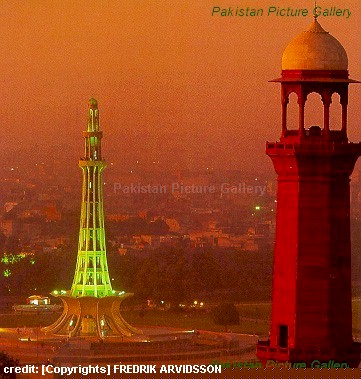
Minar-e-Pakistan is a tall minaret in Iqbal Park Lahore, built in commemoration of the Lahore Resolution. The minaret reflects a blend of Mughal and modern architecture, and is constructed on the site where on March 23, 1940, seven years before the formation of Pakistan, the Muslim League passed the Lahore Resolution (Qarardad-e-Lahore), demanding the creation of Pakistan. This was the first official declaration to establish a separate homeland for the Muslims living in the subcontinent. Pakistan now celebrates this day as a national holiday each year.
The monument attracts visitors from all over Pakistan, as well as the inhabitants of the Walled City of Lahore. The large public space around the monument is commonly used for political and public meetings, whereas Iqbal Park area is ever so popular among kite-flyovers.
Importance:
Minar-i-Pakistan is one of the most important national monuments of the country. The site where the Minar-e-Pakistan is built is the exact place where the historic Pakistan Resolution was passed in 1940. The Minar expresses the spirit of that movement. It is one of the few additions to a conglomeration of old monumental structures that are in Lahore that were mostly built by Mughals. The base of the structure takes the shape of a five point star and is enclosed within crescent shaped pools. The overall height is approximately sixty meters and the entire structure is constructed of rein forced concrete and furbished with stone and marble walls and floors.
Design:
The tower was designed by Naseer-ud-Deen Murat Khan a Pakistani architect of (Daghestan) Russian descent,and structural engineer was Abdur Rahman Khan Niazi. The design approved by the President was built by Mian Abdul Khaliq and Company.The foundation stonewas laid on March 23, 1960. The construction took eight years of time, and was completed in 1968. The Minar was completed on 31 October 1968 at an estimated cost of Rs. 7.5 million. The money was collected by imposing additional tax on the cinema and horse racing tickets. Today, the minaret provides a panoramic view to visitors who can climb up the stairs or through an elevator. The parks around the monument include marble fountains and an artificial lake.
Structure:
The base is about 8 meters above the ground. The tower rises about 60 meters on the base, thus the total height of minaret is about 72 meters above the ground. The unfolding petals of the flower-like base are 9 meters high. The diameter of the tower is about 97.5 meters (320 feet). The base platform is shaped like a five-pointed star and encloses two crescent shaped pools. There is a central spiral staircase rising up with 162 steps. The top-dome of the minaret is made of Stainless steel inlaid with fine glass pieces.
WHY we build it?
The structure is made of reinforced concrete,stones, and marble.The rostrum is built of patterned tiles, and faces the Badshahi Mosque.The base comprises four platforms. To symbolise humble beginnings of the freedom struggle, first platform is built with uncut Taxila stones, second platform is made of hammer-dressed stones, whereas third platform is of chiselled stones. Polished white marble at the fourth and final platform depicts the success of the Pakistan Movement . Mr. Mukhtar Masood a prolific writer and the then deputy commissioner of Lahore was responsible for the construction of this monument.
Cultural determinism may be all-embracing but it is not all-powerful. Men have imagination and creativity .They have personal will and, if they are not defeatist, they have inner freedom in the most enslaved circumstances. And it is not impertinent to say that they also have courage.
It is from the wellsprings of the past, with the freshness or its eternal waters that a nation drinks to revive its old and faltering heart. Monuments are a fountainhead of its reinvigoration, and they help supply nutrients to bind the sinews of National cohesion. They prove that a nation has heritage and history —and memory, and one without memory is without hope. The past is not merely a vanished tableau. It is the bedrock of the future.
A monument is less for the individual than for the collective psyche. That is why it usually stands not in a private sanctum but in public setting within the easy view of all. It is normally on high ground or platform, a source of pride and power, at once a shared spectacle and a shared experience. They represent heroes of Pakistan not only for its entire citizen but they stand equal of heroes in other lands. No challenge obtrudes on the universality of their cause except in the vainly disputations.
Founder of Pakistan said:
M A Jinnah, the Founding Father of Pakistan often said , is history continuous of struggle for freedom , freedom enjoyed , freedom lost , freedom regained , lost again , pursued again, regained , lost again.
Dr. Allama Iqbal said:
“It is by rising to a fresh vision of his origin and future, his whence and whither, that man will eventually triumph over a society motivated by inhuman competition and a civilisation which has lost its spiritual unity by its inner conflict of religions and political values.”
This unending pulsating rhythm of Pakistan freedom struggle has been the distinctive character of Pakistan’s’ national life for centuries, and in the withering process not a few larger-than-life heroes Pakistan have produced but many.
Allama Iqbal thought about human freedom:
Pakistan have suffered more miseries from the European invaders, Consumerism, imperialism and terrorism, they have been badly battered repeatedly, and culturally marinated. They have been occupied, but in the real sense Pakistan remained unvanquished. The foreign entities may destroy their monuments, but not the memory.
Pakistan heroes have been fighting for freedom. To them freedom is more important than life itself, the latter is nothing without the former. Because of this, Pakistan’s history hinges on the twin values of sacrifice and valour in the Islamic pursuit of freedom. Dr. Allama Iqbal, an ardent advocate of the concept of human freedom and evolution explains the concept of tawh?i?d beautifully when he says, “Reality is essentially spirit,” yet he qualifies his belief by mentioning that there are degrees of reality reflecting degrees of spirit. He writes:
Indeed the evolution of life shows that, though in the beginning the mental is dominated by the physical, the mental as it grows in power, tends to dominate the physical and may eventually rise to a position of complete independence…
Goals:
Life can be sacrificed for freedom, but freedom cannot be sacrificed for life. Every individual has the Goal and duty of safeguarding that freedom. Even if it causes him his life. ” the metaphysical ego is the bearer of two main rights that is the right to life and freedom as determined by Divine Law. ”Dr. Allama Iqbal, believed that behind the process of evolution is the vital impulse (Bergson’s elan vital) of ‘ishq or love which is metaphysical in nature and which makes life grow towards higher evolutionary GOALS.
It is love that imparts colour to the tulip
It is love that agitates our life.
If you could rip open the heart of the earth
You would see love’s blood coursing through it.
Beneath this visible evolution of forms is the force of love which actualises all strivings, movement and progress. Things are so constituted that they hate non-existence and love the joy of individuality in various forms. The indeterminate matter, dead in itself, assumes or more properly is made to assume by the inner force of love, various forms and rises higher and higher in the scale of beauty.
But this
“Forward push to life cannot be called creative unless hitched to some goal.”
Iqbal believed that evolution has a goal. “In fact, the evolution or dissolution of life is dependent on how far the individual chooses to use his or her creative will and power. The perfect man of Iqbal’s conception is of muja?hid, one who is ready and willing to face the problems of life, culture and society as he is to face the problems of after-life, spiritual welfare and death.”
The past has already lost print as its exclusive rendition. This century and the next, the printed world will give way to the electronic image. Communication will largely be in visual flashes rather than in syllables. Is the age of banality at hand? Will history become insipidity? It may become artless—or on the other hand acquire character of a new art form? Or it will still remain a sculptural perfection signifying human, freedom and Islam in the eyes of Allah and the rest of the world? Would the memory of Dr. Allama Iqbal,Quaid – i – Azam) Muhammad Ali Jinnah, the great men and women, will become relics in a strange epoch of new paradigms? Would arduous nationhood be a thing of the past and their parched sacrifices be regarded as crude baubles? Would the joys become outdated, the sorrows and sadness not even recalled in the consciousness of the future Pakistan?.
“Arise and soar with the suns new born rays.To breathe new life into dying nights and days.”
 You see, Ryan Thompson tricked Carly Kennedy into thinking the plane was
going down and the flight controls weren’t responding so she could read
him the instructions on what to do. Those instructions were, of course,
altered to reveal his proposal.
You see, Ryan Thompson tricked Carly Kennedy into thinking the plane was
going down and the flight controls weren’t responding so she could read
him the instructions on what to do. Those instructions were, of course,
altered to reveal his proposal.