Wednesday, November 10, 2010

True Friendship is Like Sound Health; The Value of it is Seldom Known Until it be Lost - - Charles Caleb Colton

True friendship is like sound health; the value of it is seldom known until it be lost.         Charles Caleb Colton

Each friend represents a world in us, a world possibly not born until they arrive, and it is only by this meeting that a new world is born.   Anais Nin

A single rose can be my garden... a single friend, my world.   Leo Buscaglia


In everyone's life, at some time, our inner fire goes out.  It is then burst into flame by an encounter with another human being.  We should all be thankful for those people who rekindle the inner spirit.     Albert Schweitzer


Silences make the real conversations between friends.  Not the saying but the never needing to say is what counts.        Margaret Lee Runbeck


Love is like the wild-rose briar;
Friendship is like the holly-tree.
The holly is dark when the rose briar blooms,
But which will bloom most constantly?
 Emily Brontë


When we honestly ask ourselves which person in our lives mean the most to us, we often find that it is those who, instead of giving advice, solutions, or cures, have chosen rather to share our pain and touch our wounds with a warm and tender hand.  The friend who can be silent with us in a moment of despair or confusion, who can stay with us in an hour of grief and bereavement, who can tolerate not knowing, not curing, not healing and face with us the reality of our powerlessness, that is a friend who cares.    Henri Nouwen


Bad Friend
They gather quickly with plans
At your expense
Fonder memories gather in gutters
It was there in the faces all along
The truth you didn't see
For want of friends
Loneliness does that
On dreary days when yourself is locked
Away……………………. G E Barr

False friends are worse than open enemies.         Proverb

It is easier to forgive an enemy than to forgive a friend.    William Blake
 
 Do not put your trust in a bad companion nor even trust an ordinary friend, for if he should get angry with you, he may bring all your secrets to light.         Chanakya

No good friends, no bad friends; only people you want, need to be with. People who build their houses in your heart.          Stephen King

Saturday, November 6, 2010

Nature, Background and Philosophy of Eid al-Adha (Eid-ul-Azha) - - Remembrance of Prophet Ibrahim's Sacrifice

What is Eid al-Adha (Festival of Sacrifice)..??

At the end of the Hajj (annual pilgrimage to Makkah), Muslims throughout the world celebrate the holy day of Eid al-Adha (Festival of Sacrifice). In 2010, Eid al-Adha will begin on approximately November 16th/17th, and will last for three days.

It is the second of the two major Muslim holy days. The other is Eid-ul-Fitr which follows Ramadan -- a lunar month of partial fasting. 

It is celebrated on the 10th of Zul-Hijjah, the last month of Islamic calendar. Because the date of the Feast of Sacrifice is determined by a lunar calendar, it is observed about 11 days earlier each year with respect to the Gregorian calendar. Islamic months begin at sunset on the day when the lunar crescent appears after the new moon, and can be sighted by the unaided eye.  

"Visibility depends on a large number of factors including weather condition, the altitude of the moon at sunset, the closeness of the moon to the sun at sunset, the interval between sunset and moonset, atmospheric pollution, the quality of the eyesight of the observer, use of optical aids etc." 

As a result, although the phases of the moon can be predicted accurately, the moon's visibility at a given place on Earth cannot be estimated in advance. Thus, the feast day has always been celebrated on different days in various areas of the world.


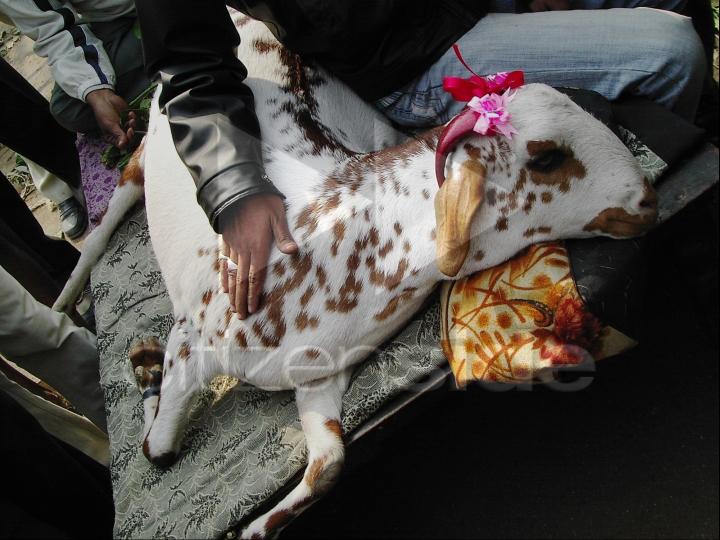
During the celebration of Eid al-Adha, Muslims commemorate and remember Ibrahim (A.S.)'s trials, by themselves slaughtering an animal such as a sheep, camel, or goat. This action is very often misunderstood by those outside the faith.

What’s The Background of Eid al-Adha..??

During the Hajj, Muslims remember and commemorate the trials and triumphs of the Prophet Ibrahim (A.S.). The Qur'an describes Ibrahim (A.S.) as follows:
"Surely Ibrahim was an example, obedient to Allah, by nature upright, and he was not of the polytheists. He was grateful for Our bounties. We chose him and guided him unto a right path. We gave him good in this world, and in the next he will most surely be among the righteous." (Qur'an 16:120-121)

One of Ibrahim (A.S.)'s main trials was to face the command of Allah to kill his only son. Upon hearing this command, he prepared to submit to Allah's will. When he was all prepared to do it, Allah revealed to him that his "sacrifice" had already been fulfilled. He had shown that his love for his Lord superseded all others, that he would lay down his own life or the lives of those dear to him in order to obey Allah (S.W.T).

What’s The Philosophy of Eid al-Adha..??

The symbolism is in the attitude - a willingness to make sacrifices in our lives in order to stay on the Straight Path. Each of us makes small sacrifices, giving up things that are fun or important to us. A true Muslim, one who submits his or herself completely to the Lord, is willing to follow Allah's commands completely and obediently. It is this strength of heart, purity in faith, and willing obedience that our Lord desires from us.

It is very important to understand that the sacrifice itself, as practiced by Muslims, has nothing to do with atoning for our sins or using the blood to wash ourselves from sin. This is a misunderstanding by those of previous generations: "It is not their meat nor their blood that reaches Allah; it is your piety that reaches Him." (Qur'an 22:37)


Allah has given us power over animals and allowed us to eat meat, but only if we pronounce His name at the solemn act of taking life. Muslims slaughter animals in the same way throughout the year. By saying the name of Allah at the time of slaughter, we are reminded that life is sacred.

The meat from the sacrifice of Eid al-Adha is mostly given away to others. One-third is eaten by immediate family and relatives, one-third is given away to friends, and one-third is donated to the poor. The act symbolizes our willingness to give up things that are of benefit to us or close to our hearts, in order to follow Allah's commands. It also symbolizes our willingness to give up some of our own bounties, in order to strengthen ties of friendship and help those who are in need. We recognize that all blessings come from Allah, and we should open our hearts and share with others.


How is Eid al-Adha Celebrated..??

Muslims around the world celebrate this feast of commitment, obedience and self-sacrifice to Allah. They wear their nicest clothing and attend Salatul-Eid (Eid Prayer) in the morning. This is followed by a short sermon, after which everyone socializes. Next, people visit each other's homes and partake in festive meals with special dishes, beverages, and desserts. Children receive gifts and sweets on this happy occasion. In addition, like the pilgrims in Makkah; the Muslims, who can afford to do so, offer domestic animals as a symbol of Ibrahim's sacrifice.

Thursday, November 4, 2010

Boredom …. Boredom is always counter-revolutionary


Before, for me, peace could have been synonymous with boredom.
Isabelle Adjani

Boredom is just the reverse side of fascination: both depend on being outside rather than inside a situation, and one leads to the other. Arthur Schopenhauer


Boredom is the dream bird that hatches the egg of experience. A rustling in the leaves drives him away. Walter Benjamin

Boredom is the feeling that everything is a waste of time; serenity, that nothing is. Thomas Szasz

All our life passes in this way: we seek rest by struggling against certain obstacles, and once they are overcome, rest proves intolerable because of the tedium it produces. Blaise Pascal

Boredom is like a pitiless zooming in on the epidermis of time. Every instant is dilated and magnified like the pores of the face. Jean Baudrillard

Boredom rests upon the nothingness that winds its way through existence; its giddiness, like that which comes from gazing down into an infinite abyss, is infinite. Soren Kierkegaard

To escape boredom, man works either beyond what his usual needs require, or else he invents play, that is, work that is designed to quiet no need other than that for working in general. Friedrich Nietzsch

Nothing is so stifling as symmetry. Symmetry is boredom, the quintessence of mourning. Despair yawns. There is something more terrible than a hell of suffering -- a hell of boredom. Victor Hugo

Boredom is a vital problem for the moralist, since at least half the sins of mankind are caused by the fear of it. Bertrand Russell

Boredom is an emptiness filled with insistence. Leo Stein

Boredom flourishes too, when you feel safe. It's a symptom of security. Eugene Ionesco

The war between being and nothingness is the underlying illness of the twentieth century. Boredom slays more of existence than war. Norman Mailer

I am never bored anywhere: being bored is an insult to oneself. Jules Renard

A life lived in love will never be dull. Leo Buscaglia

The cure for boredom is curiosity. There is no cure for curiosity. Ellen Parr

Every improvement in communication makes the bore more terrible. Frank Moore Colby

The secret of being a bore is to tell everything. Voltaire

BOREDOM

Sitting all alone one day
wondering what to do
Picked up a pen and found myself
In the land of Kharmantou

The Kharmantou are little folk
Seldom seen or heard
They live in the nibs of fountain pens
Or ink that's not been stirred.


Cherish forever what makes you unique, ‘cuz you're really a yawn if it goes. Bette Midler


Every hero becomes a bore at last. Ralph Waldo Emerson

Childhood: The Best Part of Anyone's Life - - Some Beautiful Quotes About Children and Their Behaviour

We worry about what a child will become tomorrow, yet we forget that he is someone today. Stacia Tauscher


You can learn many things from children. How much patience you have, for instance.

Franklin P. Jones


In a dark moment I ask, "How can anyone bring a child into this world?" And the answer rings clear, "Because there is no other world, and because the child has no other way into it." Robert Brault


I brought children into this dark world because it needed the light that only a child can bring.

Liz Armbruster


A characteristic of the normal child is he doesn't act that way very often. Author Unknown


A child can ask questions that a wise man cannot answer. Author Unknown


Childhood is the world of miracle or of magic: it is as if creation rose luminously out of the night, all new and fresh and astonishing. Childhood is over the moment things are no longer astonishing. When the world gives you a feeling of "déjà vu," when you are used to existence, you become an adult.

Eugene Ionesco


Stay a child while you can be a child. Stephen Sondheim


All of us have moments in out lives that test our courage. Taking children into a house with a white carpet is one of them. Erma Bombeck

Truly wonderful the mind of a child is. Yoda


Old men can make war, but it is children who will make history. Ray Merritt

Children's Poetry

I am the child,

All the world waits for my coming,
All the earth watches with interest to see what I shall become.

Civilization hangs in the balance,
For what I am, the world of tomorrow will be.

I am the child,

I have come into your world,
About which I know nothing,

Why I came I know not;
How I came I know not;

I am curious;
I am interested.

I am the child,

You hold in your hand my destiny,
You determine, largely, whether I shall succeed or fail.

Give me, I pray you,
Those things that make for happiness.

Train me, I beg you,
That I may be a blessing to the world.

Author Unknown

Sunday, October 31, 2010

Hajj: Fifth Pillar of Islam - - Few Guidelines and Information About Performing Hajj

The Hajj (Pilgrimage) – Fifth Pillar of Islam:
Hajj, one of the five pillars of Islam, is a mandatory act of worship (Ibadat); means to visit the Kaa'ba in Makkah on the specified dates in the month of Zul-Hijjah (Dhul-Hijjah) and perform the religious rites in accordance with the Islamic Laws.
Following conditions have to be fulfilled before Hajj becomes a compulsory duty on mankind.


The first condition is that of being a Muslim. Non-Muslims are, first and foremost, obliged to become Muslims after which the daily, monthly, yearly and once in a lifetime duties of Islam successively become requirements. Hajj is a religious duty which must be accompanied by the correct belief in order for it to be accepted by Allah.

The second and third conditions are those of sanity and puberty. A Muslim has to have reached puberty and be of sound mind for his or her Hajj to become a duty. Divine rewards and punishments are given as a result of human choice between good and evil. Since a child or an insane person lack the ability to distinguish between good and evil, no religious duties are required of them. This principle of non-obligation is based on the following Hadith in which the Prophet (peace be upon Him)was reported to have said: "The pen is raised from (the book of deeds) of three: the sleeper until he awakes, the child until he becomes a young man, and the insane until he regains his sanity."

The fourth condition is that of ability based on the following Quranic verse:

And, pilgrimage to the House is duty on mankind to Allah for those who can find a way there.
[Noble Quran 3:97]

The fifth condition is that of a Mahram, concerns women only and could be included under the condition of ability. Since the Prophet (peace be upon him) forbade women from traveling for a distance requiring more than twenty-four hours unaccompanied by a male relative whom she can not marry (Mahram),women are not obliged to make Hajj unless they have a Mahram to accompany them. Thus, a woman without a Mahram is recommended not to try to make Hajj. However, if the woman has the means and the Mahram, she is obliged to do so.
Hazrat Ayshah asked the Prophet (peace be upon him): "O, Messenger of Allah, are women obliged to make Jihad (holy war)?" he replied, “They must make Jihad in which there is no fighting - Hajj and ‘Umrah.”
Forms of Pilgrimage (Types of Hajj):

There are three forms of Hajj:

Tamattu'- Ifrad - Qiran

Tamattu': A pilgrim wears Ihram for Umrah only during the months of Hajj, which means when he reaches Makkah, he makes Tawaf and Sa'i for ‘Umrah. He then shaves or clips his hair. On the day of Tarwiyah, which is the eighth of Zul-Hijjah (Zul-Hijjah (Dhul-Hijjah)), he puts on his Ihram for Hajj only and carries out all of its requirements.

Ifrad: A pilgrim wears Ihram for Hajj only. When he reaches Makkah, he performs Tawaf for his arrival and Sa'i for Hajj. He doesn't shave or clip his hair as he doesn't disengage from Ihram. Instead, he remains in Ihram till after he stones Jamrat Al-'Aqabah on the Eid day. It is permissible for him to postpone his Sa'i for Hajj until after his Tawaf for Hajj.

Qiran: A pilgrim wears Ihram for both ‘Umrah and Hajj or he wears Ihram first for ‘Umrah, then makes intentions for Hajj before his Tawaf for Hajj. The obligations on one performing Ifrad are the same as those on one performing Qiran, except that the latter must slaughter whereas the former is not obligated to do so. The best of the three forms is Tamattu'. It is the form that the Prophet (peace be upon him) encouraged his followers to perform. Even if a pilgrim makes intentions to perform Qiran or Ifrad he is allowed to change his intentions to Tamattu'; he can do this even after he has performed Tawaf and Sa'i.
The Journey of Hajj:


In the forenoon of the eighth day of Zul-Hijjah (Dhul-Hijjah), a pilgrim purifies himself once again by bathing as he did before ‘Umrah in the place in which he is staying, if convenient. He puts on his Ihram and says: "Here I am for Hajj. Here I am, oh Allah, here I am. Here I am. You have no partner. Here I am. Surely all praise, grace and dominion is yours, and you have no partners."

If he fears that something will prevent him from completing his Hajj he should make a condition when he makes his intentions, saying: "If I am prevented by any obstacle my place is wherever I am held up." If he has no such fear, he doesn't make this condition.

A pilgrim goes to Mina and there prays Dhuhr, Asr, Maghrib, Isha' and Fajr, shortening his four unit prayers so as to make them two units each, without combining them.


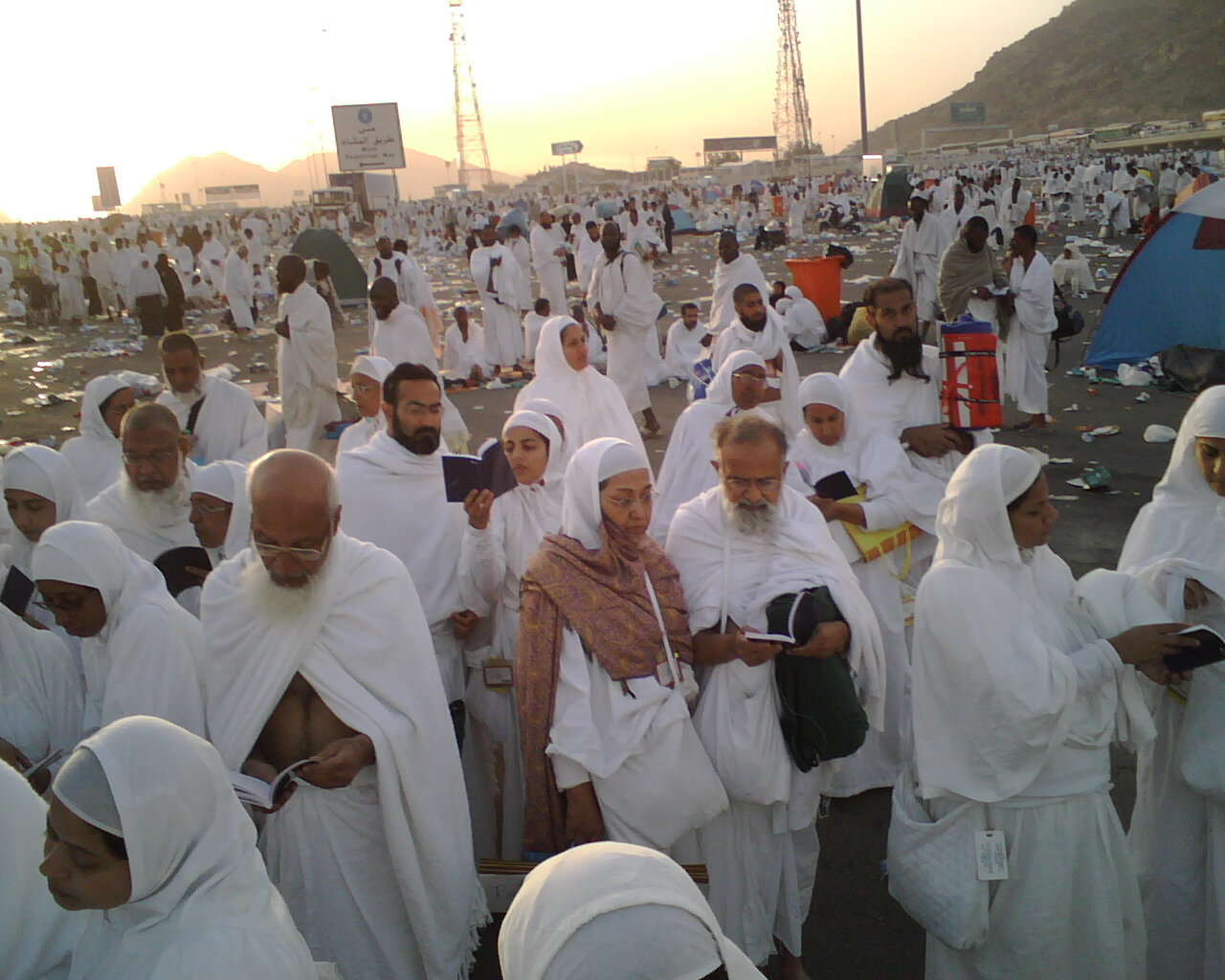
When the sun rises, he goes to Arafah and there prays Dhuhr and Asr combined at the time of Dhuhr, making each one two units. He remains in Namira Mosque until sunset if possible. He remembers Allah and makes as many supplications as possible while facing the Qiblah.


The Prophet (peace be upon him) prayed thus: "There is no Deity but Allah alone. He has no partner. All dominion and praise are His and He is powerful over all things.

If he grows weary it is permissible for him to engage in beneficial conversation with his companions or reading what he can find of beneficial books, especially those concerning Allah's grace and abundant gifts. This will strengthen his hope in Allah.


He should then return to his supplications and be sure to spend the end of the day deep in supplication because the best of supplication is the supplication of the day of Arafat.

At sunset he goes from Arafah to Muzdalifah and there prays Maghrib, Isha, and Fajr. If he is tired or has little water, it is permissible for him to combine Maghrib and Isha. If he fears that he will not reach Muzdalifah until after midnight, he should pray before he reaches it for it is not permissible to delay prayer until after midnight. He remains there, in Muzdalifah, making supplications and remembering Allah till just before sunrise.


If he is weak and cannot handle the crowd during Ar-Ramy, it is permissible for him to go to Mina at the end of the night to stone the Jamrah before the arrival of the crowd.

Near sunrise, a pilgrim goes from Muzdalifah to Mina. Upon reaching it he does the following:

He throws seven consecutive pebbles at Jamrat Al-Aqabah which is the closest monument to Makkah, saying Greatest," as he: "Allah is the throws each pebble.
He slaughters the sacrificial animal, eats some of it, and gives some to the poor. Slaughter is obligatory on the Mutamatti' and Qarin.
He shaves or clips his hair; shaving is preferable. A woman clips her hair the length of a finger tip.


These three should be done in the above order if convenient, but there is no restriction if one precedes another.

With that, one is allowed to come out of Ihram. He can wear other clothing and do everything that was lawful before Ihram except engaging in marital relations.

He goes to Makkah to perform Tawaf Al-lfadah and Sa'i, also for Hajj. It is Sunnah to put perfume on before going to Makkah.

With the completion of this Tawaf and Sa'i, a pilgrim is allowed to do everything that was lawful before Ihram, including engaging in marital relations.

After performing Tawaf and Sa'i, he returns to Mina to spend the nights of the eleventh and twelfth days there.

He stones the three Jamrah in the afternoon of both the eleventh and twelfth days. He starts with the first Jamrah, which is furthest from Makkah, then the middle one, and lastly Jamrat Al-Aqabah. Each one should be stoned with seven consecutive pebbles accompanied by Takbir. He stops after the first and middle Jamrah to make supplications facing the Qiblah. It is not permissible to stone before noon on these two days. It is best to walk to the Jamrah, but riding is permissible.


If he is in a hurry after stoning on the twelfth day, he leaves Mina before sunset. But if he wishes to prolong his stay, which is best, he spends the night of the thirteenth in Mina and stones that afternoon in the same manner as on the twelfth day.

When he is ready to return to his country, he makes Tawaf Al-Wada', which is seven circuits around the Ka'bah. Menstruating women and women experiencing postnatal discharge are not obligated to perform Tawaf Al-Wada'.
Visiting The Prophet's Mosque (Masjid-e-Nabvi):

A pilgrim goes to Medina before or after Hajj with the intention of visiting the Prophet's mosque and praying in it. Prayer there is better than a thousand prayers elsewhere except in the Holy Mosque in Makkah.


Upon reaching the mosque he prays two Rak'ah of salutation or performs any obligatory prayer that is due.

He goes to the grave of the Prophet (peace be upon him) and he stands before it. He greets him saying the "May the peace, mercy, and blessings of Allah be upon you, oh Prophet. May Allah grant you a good reward on behalf of your people."


He takes a step or two to his right to position himself before Abu Bakr and greets him saying: "May the peace, mercy, and blessing of Allah be upon you, oh Abu-Bakr, Caliph of the Messenger of Allah. May Allah be pleased with you and grant you a good reward on behalf of Muhammad's people."

Then he takes a step or two to his right to position himself before Umar and greets him saying: "May the peace, mercy and blessings of Allah be upon you, oh Umar, Prince of the believers. May Allah be pleased with you and grant you a good reward on behalf of Muhammad's people."

In a state of purity, he goes to pray in Quba' Mosque.

He goes to Al-Baqi' to visit Uthman's grave. He stands before it and greets him saying: "May the peace, mercy and blessing of Allah be upon you,

Oh Uthman Prince of the believers. May Allah be pleased with you and grant you a good reward on behalf of Muhammad's people." He greets any other Muslims in Al-Baqi'.

He goes to Uhud and visits the grave of Hamzah and the other martyrs there with him. He greets them and prays to Allah to grant them forgiveness, mercy, and pleasure.

Related Posts Plugin for WordPress, Blogger...

Smowtion

Smowtion ...